
Blog
The Tiny Cap at the End: Why So Many Peptides Finish in NH2

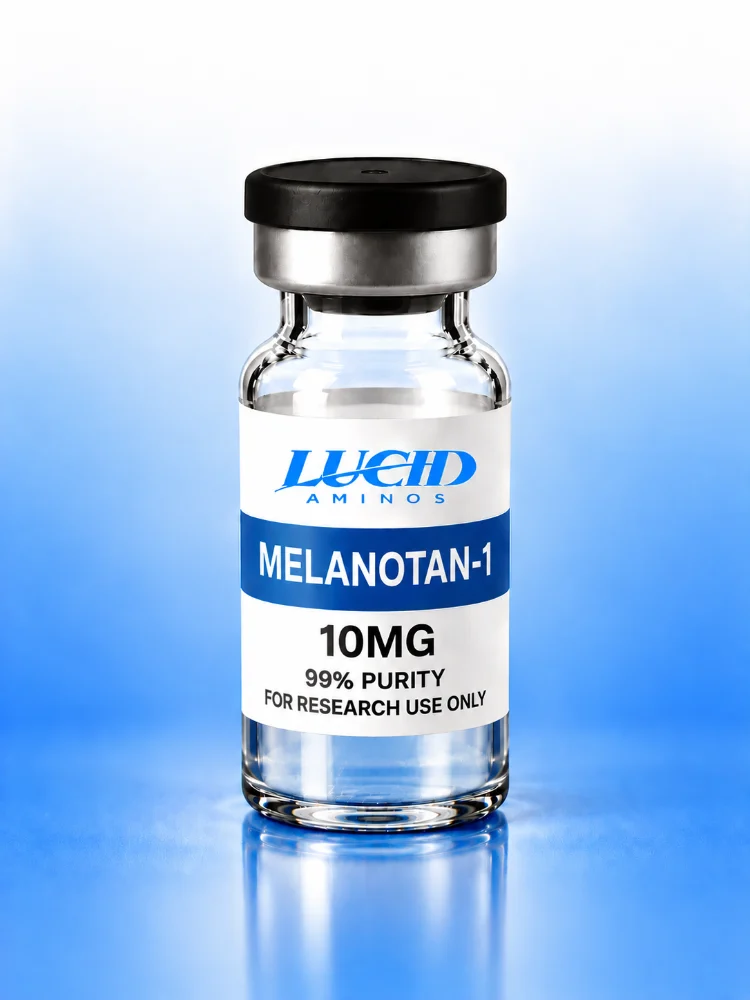
Peptides have two ends. The front has an amine (N-terminus) and the back has a carboxylic acid (C-terminus). But many of the peptides we handle swap that acid for an amide, written -NH2.
What changes
A carboxylic acid is negatively charged at neutral pH. An amide is neutral. Removing one charge changes solubility, how strongly the peptide binds to other charged surfaces, and how enzymes recognize it.
Nature does it too
Many natural peptide hormones are amidated by an enzyme called PAM. The natural growth hormone releasing hormone of 44 residues is amidated, and so is alpha-MSH. Synthetic chemists copy the cap when they want the peptide to match the natural form.
Where to look in our catalog
- Tesamorelin 10mg: ends as an amide, like the natural 1-44 sequence.
- Melanotan-1 10mg: an amide, like alpha-MSH.
- Ipamorelin: an amide on its fifth residue.
The practical angle
An amide shifts the molecular weight by about one unit compared with the free acid. That tiny difference is visible in a mass spectrum, so a COA can tell the two apart. Keep reading to see how.
Explore Lucid Aminos
- Shop all research compounds
- Read the lab reports (COA)
- Frequently asked questions
- Partner program
- About Lucid Aminos
- Contact us
For laboratory research use only. Not for human or veterinary use, and not intended to diagnose, treat, cure or prevent any condition. This article is educational and is not medical advice.