
Blog
One Peptide, Three Receptors: How Triple-Agonist Research Compounds Are Designed

This article describes published laboratory science for educational purposes. It makes no claims about use in people.
For years, peptide chemists chased one receptor at a time. Then a different idea took hold: the gut hormones GIP, GLP-1 and glucagon are related, and so are their receptors. Could one molecule speak to all three?
A family of look-alikes
All three receptors belong to the class B family of G protein-coupled receptors. When activated, they raise cyclic AMP inside the cell. The three hormones are also similar in sequence, which is what makes a hybrid possible.
The balancing act
A triple agonist must hit each receptor with the right strength. Too weak at one and the effect is lost; too strong and it dominates. Chemists tune this by swapping individual residues across the sequence and measuring each receptor in cell assays.
Making it durable
Natural gut hormones are cleared in minutes. Research compounds in this class add stabilizing residues such as Aib, which blocks the enzyme DPP-IV, and lipid chains for longer circulation (more on that in our companion article).
Why researchers care
- It tests how receptor signals combine.
- It shows how far a single sequence can be pushed.
- It is a case study in modern peptide engineering.
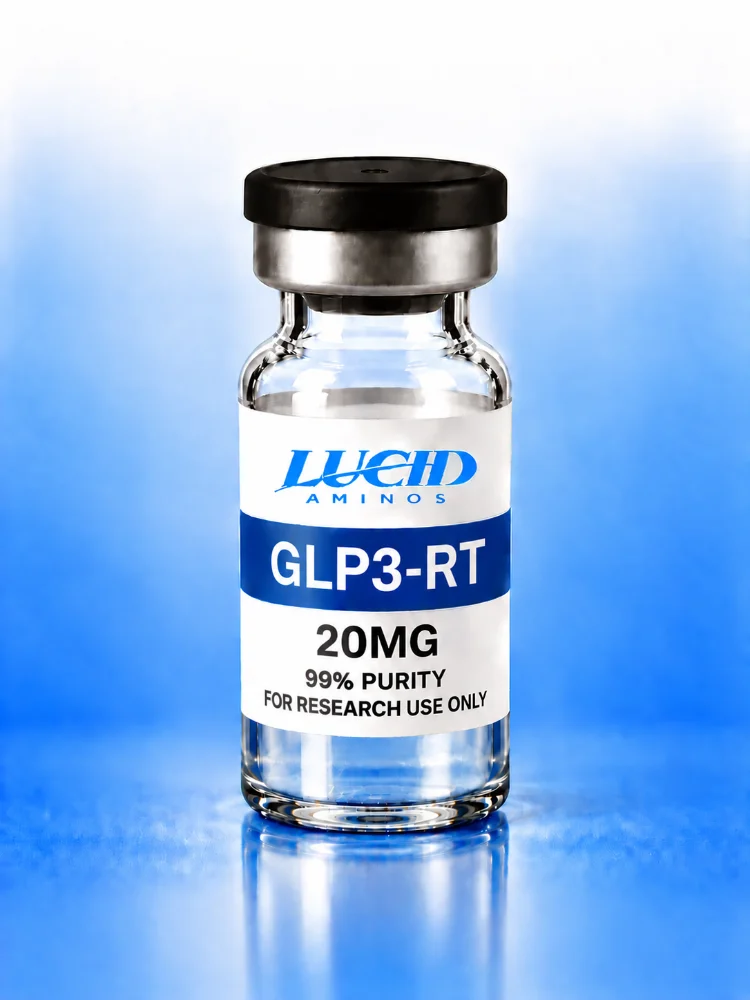
Our GLP3-RT listing is sold strictly for laboratory research use. Keep reading to see how the lipid chain works.
Explore Lucid Aminos
- Shop all research compounds
- Read the lab reports (COA)
- Frequently asked questions
- Partner program
- About Lucid Aminos
- Contact us
For laboratory research use only. Not for human or veterinary use, and not intended to diagnose, treat, cure or prevent any condition. This article is educational and is not medical advice.