
Blog
Glucagon and the Discovery of Cyclic AMP: The Story Behind a Triple-Agonist Ingredient

This article describes published laboratory science for educational purposes. It makes no claims about use in people.
Glucagon is a 29-amino-acid hormone made in the pancreas. It was identified in 1923, only two years after insulin, when researchers noticed that crude insulin extracts first raised blood sugar before lowering it. The extra ingredient got a name: glucagon.
A hormone that led to a messenger
In the 1950s, Earl Sutherland studied how glucagon and adrenaline made liver cells release glucose. He found that the hormones did not enter the cell. Instead, they triggered production of a small molecule inside it: cyclic AMP. This was the first “second messenger” ever described, and it earned him the 1971 Nobel Prize in Physiology or Medicine.
Why it matters now
The glucagon receptor, like the GIP and GLP-1 receptors, raises cAMP when activated. Triple-agonist research peptides are designed to engage all three, so understanding cAMP signaling is the foundation for reading any experiment on them.
How labs measure it
- cAMP assays in cultured cells
- Reporter gene readouts
- Dose-response curves
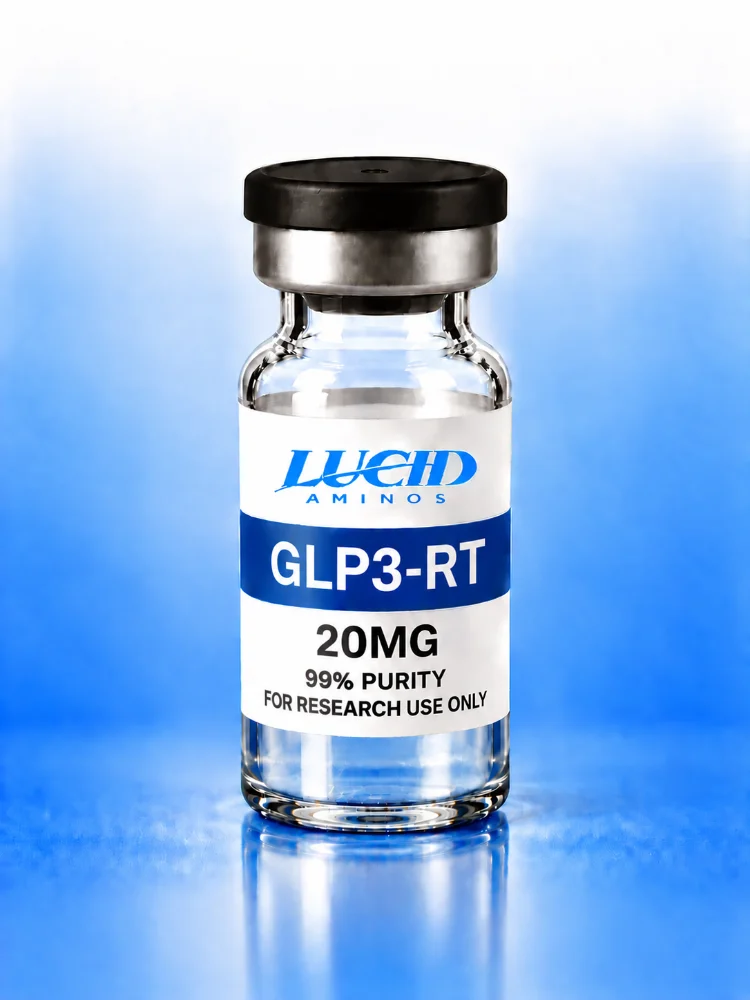
Our GLP3-RT listing is sold strictly for laboratory research. Keep reading for how a 4.7 kDa peptide shows up on a mass spectrometer.
Explore Lucid Aminos
- Shop all research compounds
- Read the lab reports (COA)
- Frequently asked questions
- Partner program
- About Lucid Aminos
- Contact us
For laboratory research use only. Not for human or veterinary use, and not intended to diagnose, treat, cure or prevent any condition. This article is educational and is not medical advice.