
Blog
Growth Hormone Secretagogues and Hair Follicle Research

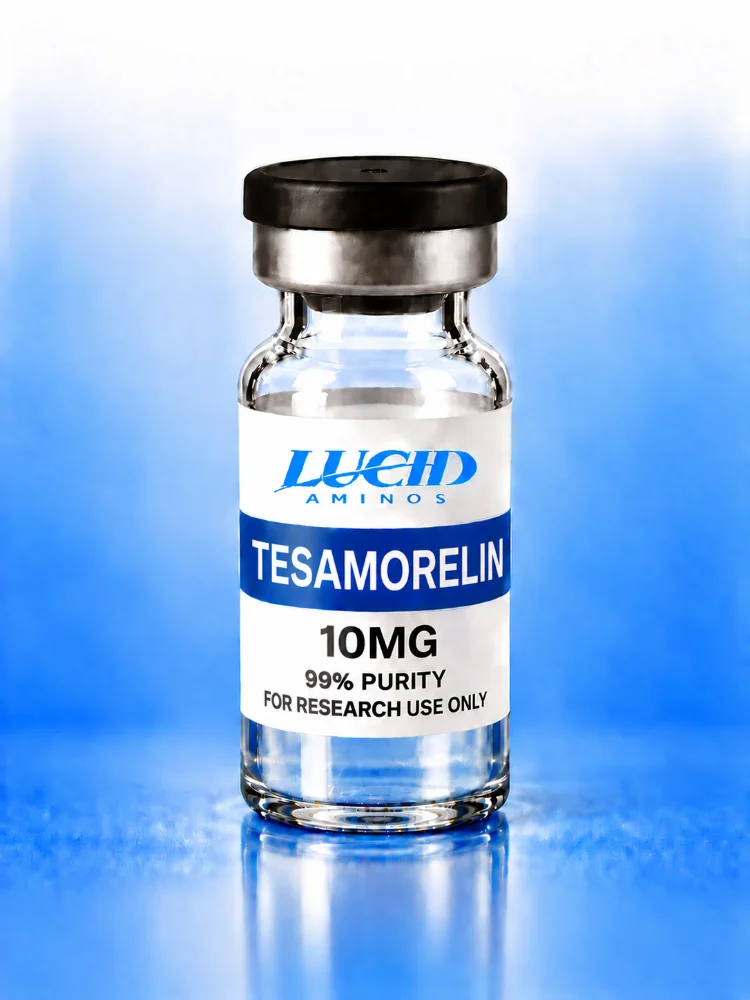
Growth hormone shapes tissues from bone to skin. Growth hormone secretagogues hair research asks whether compounds that prompt the pituitary gland to release growth hormone could influence follicle biology through the IGF-1 pathway.

What secretagogues are
Growth hormone secretagogues are compounds that stimulate natural growth hormone release rather than supplying the hormone itself. CJC-1295 mimics growth hormone releasing hormone, ipamorelin acts on the ghrelin receptor, and tesamorelin is a stabilized releasing hormone analog.
They are used in laboratory research to study the growth hormone axis.
The IGF-1 connection
Growth hormone prompts the liver and other tissues to make IGF-1. Dermal papilla cells carry IGF-1 receptors, and in culture IGF-1 prolongs the growth phase of isolated follicles.
This is the logical link behind growth hormone secretagogues hair studies.
What is actually known
Direct hair outcome data for these compounds are scarce. Most evidence concerns growth hormone release, body composition and metabolic markers.
Linking them to follicles is therefore an open research question, not an established effect.
How a study would work
Researchers could treat animal models or follicle cultures with secretagogues or IGF-1 and measure shaft elongation, cycle stage and papilla signaling.
Hormone levels vary by hour, so sampling time must be standardized.
Quality and handling
These peptides are fragile. Reconstitute with bacteriostatic water, store cold and protected from light, and verify purity with a certificate of analysis.
Reliable growth hormone secretagogues hair experiments depend on documented, stable material.
How to read the literature on growth hormone secretagogues hair
Start by checking the model. A result in cultured cells is a first clue, a result in isolated follicles is stronger, and a result in a living system is stronger still. Next, look at the controls: a credible paper includes an untreated group, a vehicle group and, where possible, a known positive control. Finally, look for blinding and pre-stated endpoints, because they separate real signals from hopeful interpretation.
Be careful with review articles that blend animal data, cell data and anecdotes into a single narrative. When reading about growth hormone secretagogues hair, trace each claim back to the original experiment and note the species, dose, timing and measurement method.
A practical research checklist for growth hormone secretagogues hair
- Define one narrow, testable question before choosing a model.
- Pick measurements that match the hair cycle, such as shaft elongation or cycle stage counts.
- Record peptide source, batch number, purity and storage for every run.
- Reconstitute carefully with bacteriostatic water and avoid repeated freeze and thaw cycles.
- Replicate the result before building on it.
Where growth hormone secretagogues hair research is heading
The field is moving toward three-dimensional follicle models, single cell sequencing and longer observation windows. These tools let scientists see which cell types respond to a signal and how long the response lasts, which is exactly what simple dish experiments cannot show.
As these methods spread, expect more careful and more modest claims. That shift is healthy: honest, well-controlled work on growth hormone secretagogues hair is what ultimately makes the whole field more reliable.
Key takeaways
- Secretagogues prompt natural growth hormone release.
- IGF-1 is the plausible bridge to follicles.
- Direct hair data are limited.
- Standardize sampling and verify material quality.
Frequently asked questions about growth hormone secretagogues hair
Is this research done in people?
Most of the work described here comes from cell cultures, isolated follicles and animal models. Human studies are limited, which is why the conclusions stay cautious.
Why do hair studies take so long?
The hair cycle runs for months and years, so a meaningful experiment needs long timelines and repeated, objective measurements.
Are Lucid Aminos products for human use?
No. All compounds are sold strictly for laboratory research use only and are not intended for human consumption or to treat any condition.
Browse the research compounds
Researchers following this topic often work with CJC-1295 / Ipamorelin Blend, Tesamorelin, Bacteriostatic Water. Every batch has its own report on the COA page, and you can browse the full shop for all research compounds.
Related reading
- Igf 1 And Hair Growth Signaling Peptides
- Hair Growth Cycle Explained Where Peptide Research
- Hair Follicle Study Design
Educational content only. All compounds sold by Lucid Aminos are for laboratory research use only and are not for human consumption. This article is not medical advice. If you are concerned about hair loss or scalp problems, speak with a qualified clinician.
Explore Lucid Aminos
- Shop all research compounds
- Read the lab reports (COA)
- Frequently asked questions
- Partner program
- About Lucid Aminos
- Contact us
For laboratory research use only. Not for human or veterinary use, and not intended to diagnose, treat, cure or prevent any condition. This article is educational and is not medical advice.