
Blog
The 10-Degree Rule: How Temperature Changes Peptide and NAD+ Stability

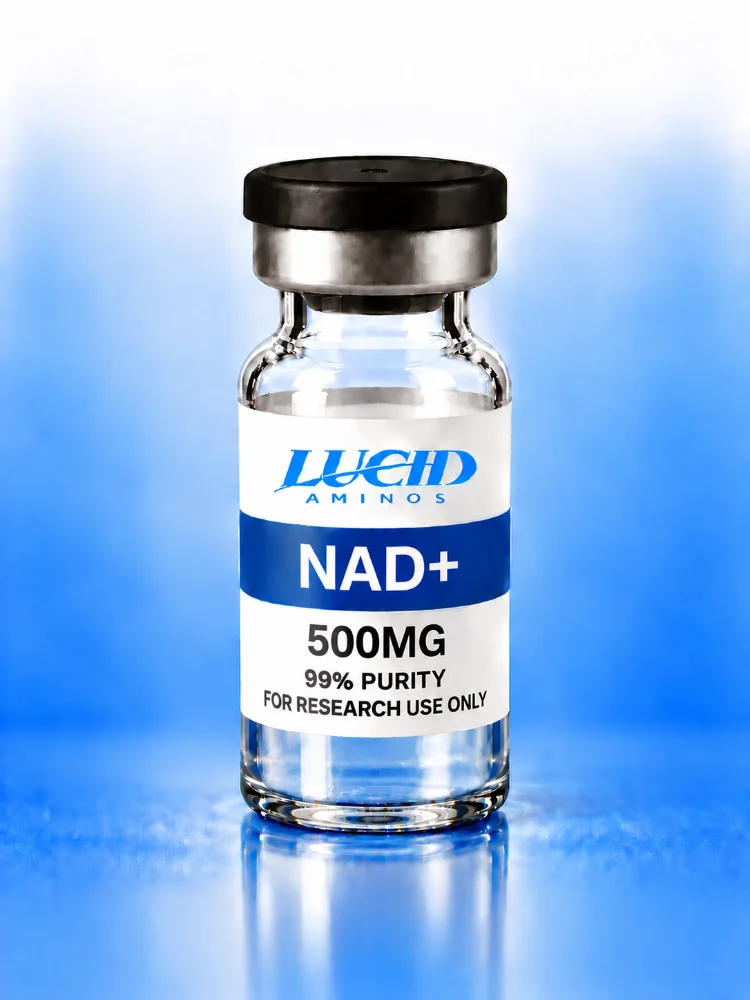
If you have ever wondered whether leaving a vial out for an afternoon matters, chemistry has a useful rule of thumb. For many reactions, the rate roughly doubles to triples for every 10 degrees Celsius increase in temperature. The size of that effect is why storage temperature is the first line of every handling guide.

Key takeaways
- A rise of 10 degrees Celsius often speeds up degradation two to threefold (a Q10 of 2 to 3).
- Moving from refrigerator to room temperature can multiply the rate several times.
- Dry solids degrade much more slowly than solutions at the same temperature.
- Short excursions matter less than long ones, but they are not free.
Where the rule comes from
The Arrhenius equation relates a reaction rate constant to temperature: the rate depends on an exponential of the activation energy divided by the gas constant and the absolute temperature. Reactions with a higher activation energy are more sensitive to heat. A Q10 value expresses the same effect simply as the factor by which the rate changes per 10 degrees.
Worked numbers
Take a Q10 of 2, a modest value. Going from 5 degrees (a refrigerator) to 25 degrees (room temperature) is two steps of 10 degrees, so the rate is 2 times 2, or about 4 times faster. With a Q10 of 3, it is about 9 times faster. From 5 degrees to 37 degrees, a bit over three steps, a Q10 of 2 gives roughly 9 times and a Q10 of 3 roughly 40 times. These are illustrations of the arithmetic, not measured shelf lives, because the real Q10 differs by molecule and pathway.
Why dry storage changes the picture
In a lyophilized solid, molecules are locked in place and there is little water to take part in reactions. Degradation is slower by a large factor, but it is not zero, and residual water and a glass transition can complicate it. The effect of moisture is discussed in our residual moisture article. In solution the same compound often follows paths such as those described under deamidation and oxidation, each with its own temperature dependence.
Freezing is not a perfect pause
Freezing slows chemistry sharply, but freezing a solution concentrates the dissolved components in the unfrozen fraction, and it can shift pH as buffer salts crystallize at different rates. Repeated freeze-thaw cycles also stress the sample. That is why splitting into single-use portions is a common recommendation.
Mean kinetic temperature
Pharmaceutical logistics use a concept called mean kinetic temperature (MKT) to summarize a varying temperature history as the single constant temperature that would cause the same degradation. Because of the exponential relationship, hot periods count disproportionately. A package that spends a few hours very hot can have a higher MKT than its average temperature suggests. Our post on cold chain myths looks at what this means for shipping.
Practical guidance
- Keep sealed, dry material cold and dark unless instructions say otherwise.
- Allow a cold vial to reach room temperature before opening to prevent condensation.
- Return unused material to cold storage promptly.
- Log temperature excursions with dates so unusual results can be traced.
The bottom line
The rule of thumb will not give you an expiry date, but it explains why careful temperature control costs little and protects a lot.
Related reading
- How to Store Lyophilized Peptides: A Practical Lab Guide
- Cold-Chain Myths: Does Every Research Peptide Really Need Ice Packs?
- Residual Moisture in Freeze-Dried Peptides and Karl Fischer Testing
- Browse the full Research Library
For laboratory research use only. Not for human or veterinary use, and not intended to diagnose, treat, cure or prevent any condition. This article is educational and is not medical advice.