
Blog
Peptide Salt Forms: Acetate, TFA and Hydrochloride, and Why Net Peptide Content Changes

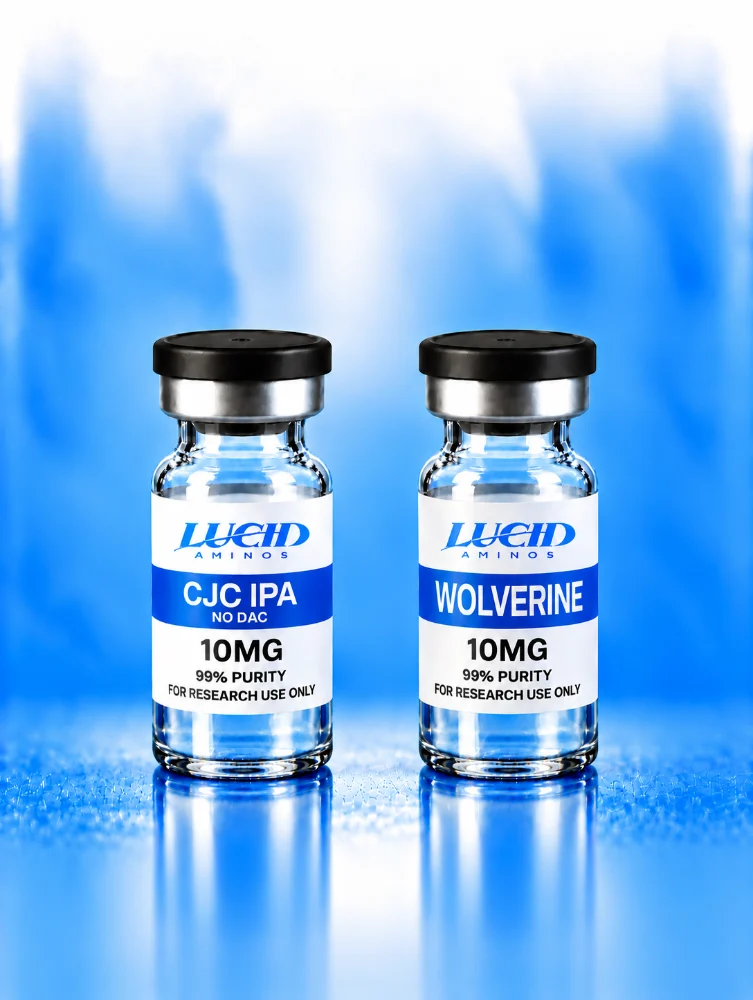
A vial labeled 10 mg of a peptide does not hold 10 mg of peptide. It holds a salt of the peptide, plus some water, and the proportions depend on how the material was made and purified. This is normal, and it is one of the most useful things a researcher can understand before doing any calculation.

Key takeaways
- Peptides are positively charged at many positions and carry negatively charged counterions.
- After standard purification, the counterion is often trifluoroacetate (TFA).
- Acetate and hydrochloride are common alternatives.
- Counterions and water mean the net peptide content can be well below 100 percent of the weight.
- TFA can affect some cell assays and some spectroscopy.
Where the counterions come from
Peptides contain basic groups, including the N-terminus and the side chains of lysine, arginine and histidine, that carry a positive charge in solution. In the solid state, each charge needs a negative partner. During synthesis the peptide is cleaved from the resin in strong trifluoroacetic acid, and HPLC purification often uses TFA as an ion-pairing agent, as covered in our ion-pairing post. The peptide therefore tends to end up as a TFA salt.
Why it matters
- Weight: a peptide with several basic residues can carry several TFA molecules, adding a substantial share of the mass.
- Solubility: different salts dissolve differently and give different pH values.
- Hygroscopicity: some salts pull water from the air, making the powder sticky and hard to weigh. See lyophilization and residual moisture.
- Biology: TFA has been reported to affect cell growth in some assays at certain concentrations.
- Analysis: TFA has an infrared band near the peptide amide region that can interfere with spectroscopy.
Net peptide content
Net peptide content is the percentage of the powder that is actual peptide, once counterions and water are removed. It is measured by methods such as amino acid analysis or elemental analysis. A product with a purity of 99 percent by HPLC may still have a net peptide content well below 100 percent, often somewhere around 60 to 85 percent, because HPLC purity only compares peptide-related peaks and does not count salt or water. Our purity post explains the distinction.
Salt exchange
If TFA is a problem, researchers can swap it for acetate or hydrochloride. Common ways include passing the peptide through an ion-exchange resin, repeated dissolving and freeze-drying in dilute hydrochloric acid, or using an acetic acid mobile phase for purification. Each method has trade-offs: strong acid can damage sensitive sequences, and exchange can reduce yield. The change should be verified by a measurement, such as ion chromatography.
Practical advice
- Ask what salt form a lot is supplied in before calculating molar concentrations.
- Use net peptide content, not gross weight, for molarity, or measure the stock by absorbance.
- Keep powders sealed and let them reach room temperature before opening.
- Use the same salt form across experiments you intend to compare.
- Record the counterion in your notebook.
The bottom line
Salt form is easy to overlook and easy to control. Knowing it makes your numbers more accurate and your comparisons fairer. Browse our research compounds and read each lab report for the documentation available.
Related reading
- Ion pairing with TFA
- Why purity alone is not enough
- Lyophilization explained
- Browse the full Research Library
Explore Lucid Aminos
- Shop all research compounds
- Read the lab reports (COA)
- Monthly Research Panel
- Frequently asked questions
- Partner program
- About Lucid Aminos
- Contact us
For laboratory research use only. Not for human or veterinary use, and not intended to diagnose, treat, cure or prevent any condition. This article is educational and is not medical advice.