
Blog
Why GHK-Cu Solutions Look Blue: Copper Complex Color as a Quick Visual Check

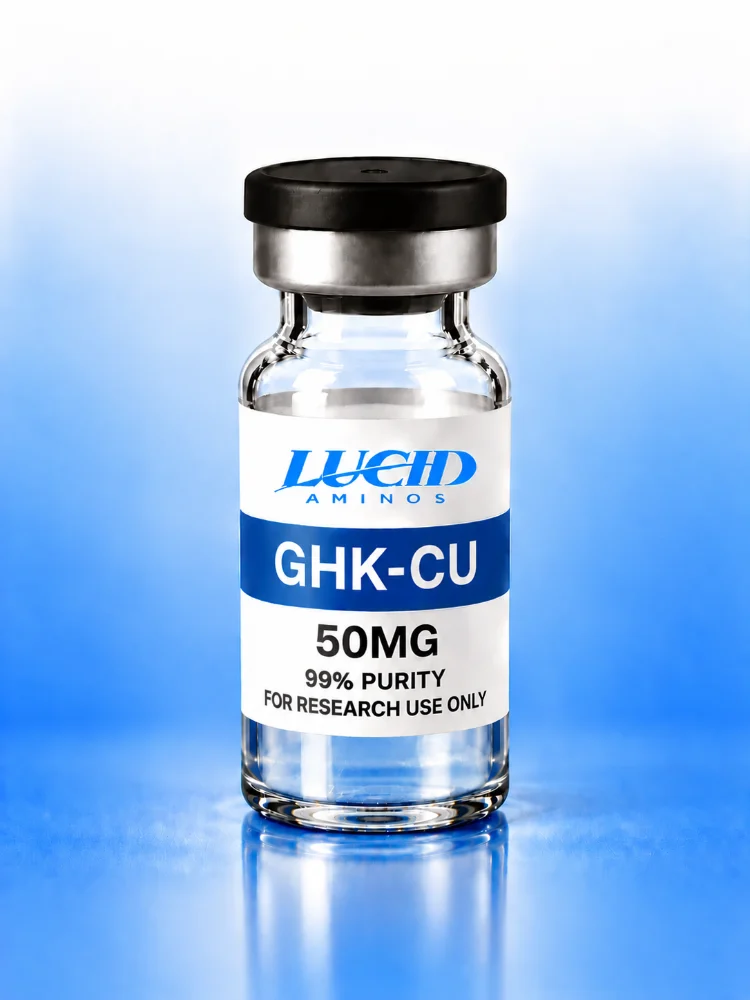
Open a vial of GHK-Cu and dissolve it, and the first thing you notice is color. The powder and solution are blue, a feature the free tripeptide does not have. That color is chemistry you can see, and it tells you something useful, though less than people sometimes assume.

Key takeaways
- GHK is the tripeptide Gly-His-Lys with a mass near 340 daltons; GHK-Cu is its copper(II) complex, near 402.
- Copper(II) ions absorb light in the red and orange range, so the complex looks blue.
- Binding uses the amino end, the histidine ring and nearby backbone nitrogens.
- Color is a hint of copper binding, not proof of identity or purity.
- Deeper color means more copper-bound peptide per volume.
Why copper makes color
Copper(II) has a partly filled set of d electrons. When surrounding atoms form a complex around it, the electrons can absorb a small amount of visible light, mostly in the orange and red. What reaches your eye is the remaining blue. Plain copper salts in water are pale blue; when a peptide binds, the shade shifts, often toward a deeper blue or blue-violet.
How GHK holds the copper
The peptide grips the metal like a claw. The free amino group at the glycine end, the nitrogen of the histidine ring, and backbone nitrogen atoms all donate electron pairs to the copper. The lysine side chain stays outside and keeps the complex soluble. The detailed picture is in our copper-binding chemistry post, and the discovery in the Pickart story.
What the color can tell you
- A clear blue solution is consistent with copper being bound to the peptide.
- A very pale or colorless solution at a reasonable concentration may point to little or no copper.
- Greenish or brownish shifts can reflect pH changes, other ions or degradation.
- Intensity rises with concentration, so compare solutions only at similar dilutions.
What it cannot tell you
Color does not reveal the peptide sequence, the purity, or the exact copper ratio. A copper salt added to a different peptide that has a histidine could also turn blue. Identity needs a measured mass and an HPLC trace, as described in HPLC versus mass spectrometry and why purity alone is not enough.
Handling notes
Copper complexes can be sensitive to strongly acidic or very basic conditions and to competing chelators such as EDTA, which can pull the metal away. Keep stocks cold, avoid contaminating them with chelating buffers, and note any color change. See how cells handle copper for biological context.
Related reading
Explore Lucid Aminos
- Shop all research compounds
- Read the lab reports (COA)
- Monthly Research Panel
- Frequently asked questions
- Partner program
- About Lucid Aminos
- Contact us
For laboratory research use only. Not for human or veterinary use, and not intended to diagnose, treat, cure or prevent any condition. This article is educational and is not medical advice.