
Blog
Sanger and Insulin: How 51 Amino Acids Were Read for the First Time

Before 1955, nobody had ever read the full amino acid sequence of a protein. Many chemists believed proteins were loose, irregular mixtures. Frederick Sanger, working in Cambridge, set out to prove they were precise molecules with a fixed order of parts. His test subject was insulin, which has two chains: an A chain of 21 residues and a B chain of 30, joined by disulfide bridges.
The trick: label the end, then cut
Sanger used a reagent, 1-fluoro-2,4-dinitrobenzene (often called Sanger’s reagent), that attaches a yellow tag to a free N-terminal amino group. When he then broke the chain into pieces with acid and enzymes, the tagged amino acid at the front of each piece could be identified. Repeat this on overlapping fragments and you can stitch the order together, like assembling a sentence from torn strips of paper.
Splitting the chains
The two insulin chains were held together by disulfide bonds, so he first oxidized them apart with performic acid. Each chain was then fragmented separately and the pieces were sorted by paper chromatography, a technique that moves molecules across filter paper at different speeds. The B chain was finished around 1951 and the A chain around 1953. The disulfide pattern followed in 1955, and Sanger received the 1958 Nobel Prize in Chemistry.
Why it still matters at the bench
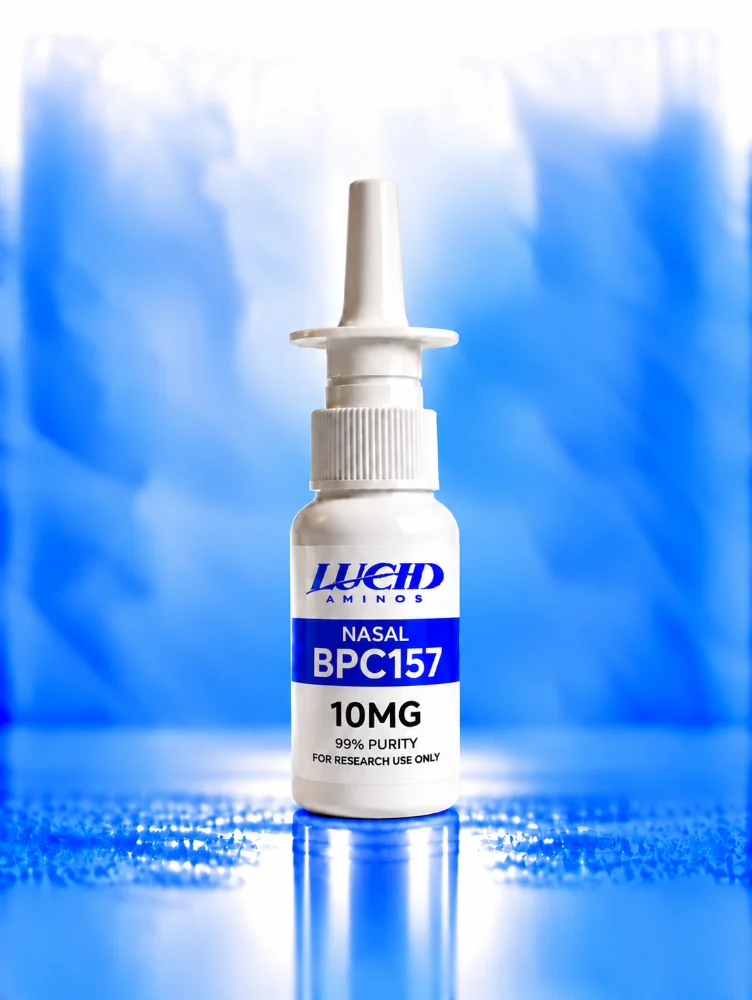
Modern labs read sequences with mass spectrometry instead of yellow dye, but the logic is identical: fragment, measure, and reassemble. When a certificate of analysis shows a mass that matches a predicted sequence, it relies on the same idea Sanger proved, that a peptide has one defined order of residues. You can practice the reading yourself with a short sequence such as Nasal BPC-157 10mg, a 15-residue peptide whose fragments can be predicted residue by residue.
Take-home
- A peptide is a defined sequence, not a vague mixture.
- Labeling the N-terminus was the key to reading order.
- Today’s mass spectrometers inherit the same fragment-and-reassemble logic.
Explore Lucid Aminos
- Shop all research compounds
- Read the lab reports (COA)
- Frequently asked questions
- Partner program
- About Lucid Aminos
- Contact us
For laboratory research use only. Not for human or veterinary use, and not intended to diagnose, treat, cure or prevent any condition. This article is educational and is not medical advice.