
Blog
GRF(1-29) vs GRF(1-44): Why the Length of a Peptide Fragment Matters

When researchers isolated growth hormone releasing hormone in 1982, they found a 44-residue peptide. Soon afterward chemists asked a classic question: how much of it do you actually need?
The 29-residue core
Shorter versions were synthesized and tested in cell assays. The first 29 amino acids, written GRF(1-29)-NH2, kept essentially the full receptor activity. This fragment is known as sermorelin. The remaining 15 residues at the C-terminal end seemed not to be required for binding, which is a useful lesson: peptides often have a small active core inside a longer scaffold.
Why keep the long form?
The full 44-residue sequence is the natural one, and longer sequences can change how a peptide behaves in solution and how quickly enzymes chew it up. Tesamorelin keeps all 44 residues and adds a trans-3-hexenoyl group to the N-terminal tyrosine. That small cap blocks the enzyme DPP-IV, which snips two residues off the front of unprotected GRF.
Side-by-side
| Feature | GRF(1-29) | GRF(1-44) modified |
|---|---|---|
| Length | 29 residues | 44 residues |
| N-terminus | Free tyrosine | Hexenoyl-capped tyrosine |
| Approx. mass | about 3358 Da | about 5136 Da |
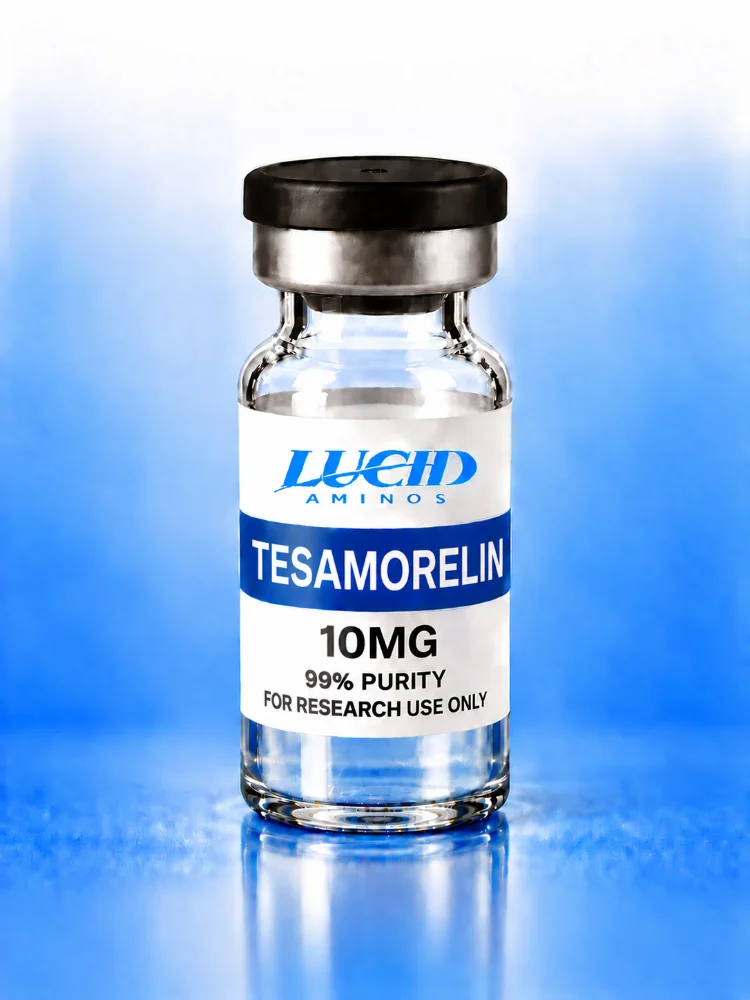
Our catalog lists Tesamorelin 10mg for the long modified form. Always confirm the mass on the certificate of analysis, because mass is the quickest way to tell fragment lengths apart.
Take-home
- A short core can carry the full activity of a longer peptide.
- A small chemical cap can change enzyme stability.
- Mass on a COA reveals which version you actually hold.
Explore Lucid Aminos
- Shop all research compounds
- Read the lab reports (COA)
- Frequently asked questions
- Partner program
- About Lucid Aminos
- Contact us
For laboratory research use only. Not for human or veterinary use, and not intended to diagnose, treat, cure or prevent any condition. This article is educational and is not medical advice.