
Blog
NAD+ Began in Boiled Yeast Juice: Harden, Young and Warburg

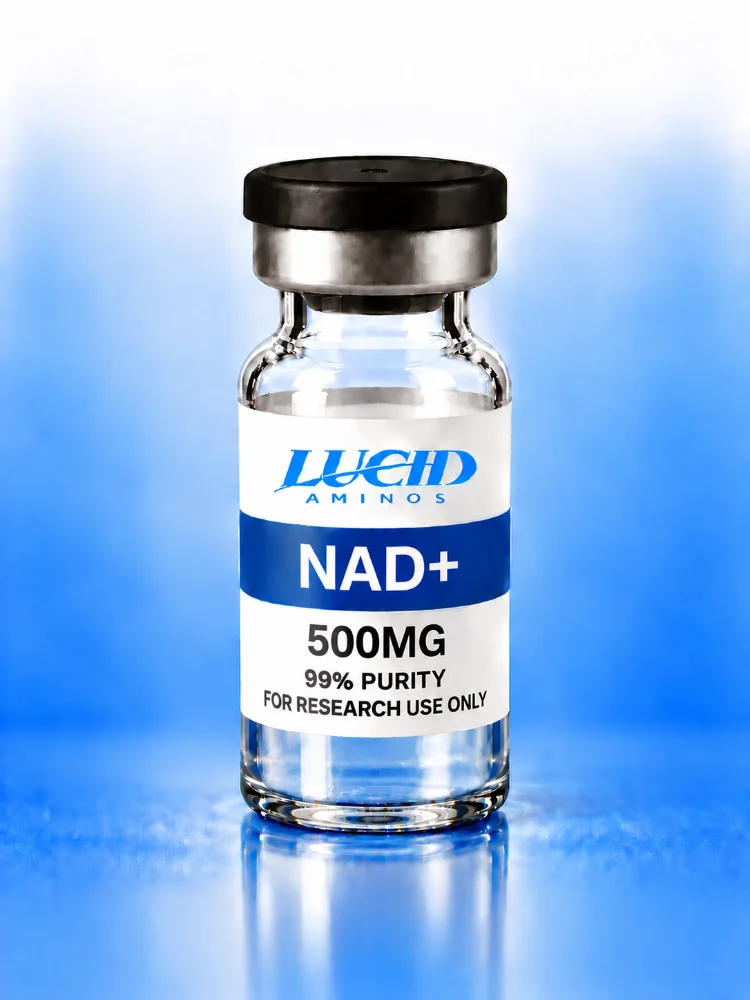
NAD+ is a dinucleotide, not a peptide, yet its history is one of the great detective stories in biochemistry and deserves a place next to the peptide tales on this site.
1906: a puzzle in fermentation
Arthur Harden and William Young were studying how yeast juice ferments sugar. They noticed that the activity faded when the juice was filtered through a membrane, but returned when they added back the boiled filtrate. The helper was small, survived heating, and passed through the filter. They had found a coenzyme, later called cozymase.
Working out the structure
Hans von Euler-Chelpin spent the following decades purifying it and showed it contained two nucleotides linked through their phosphate groups, one carrying adenine and one carrying nicotinamide. Harden and von Euler-Chelpin shared the 1929 Nobel Prize in Chemistry for this work on sugar fermentation and its enzymes.
What the nicotinamide does
In the 1930s Otto Warburg showed that the nicotinamide ring accepts and releases a hydride, which makes NAD+ a shuttle for electrons in redox reactions. The oxidized form is NAD+ and the reduced form is NADH. That simple back-and-forth sits behind a long list of enzyme reactions studied in laboratories today.
Handling note for researchers
The same chemistry that makes NAD+ useful also makes it delicate. It degrades in alkaline solution and absorbs moisture, so careful storage matters. You can see our research-grade NAD+ 500mg listing for the current specification.
Take-home
- NAD+ was discovered as a heat-stable helper of yeast fermentation.
- Its two-nucleotide structure took decades to decode.
- The nicotinamide ring is the working end of the molecule.
Explore Lucid Aminos
- Shop all research compounds
- Read the lab reports (COA)
- Frequently asked questions
- Partner program
- About Lucid Aminos
- Contact us
For laboratory research use only. Not for human or veterinary use, and not intended to diagnose, treat, cure or prevent any condition. This article is educational and is not medical advice.