
Blog
Edman Degradation: Reading a Peptide One Residue at a Time

Before mass spectrometers could sequence peptides, the standard method was Edman degradation, published by Pehr Edman in 1950.
The cycle
- Phenyl isothiocyanate (PITC) reacts with the free N-terminal amine.
- Mild acid then cuts only that first residue off as a small derivative.
- The derivative is identified by HPLC.
- The remaining peptide, one residue shorter, goes round again.
How far can it go?
Each cycle is slightly less than perfect, so the signal fades. Typically, 30 to 50 residues can be read.
The catch
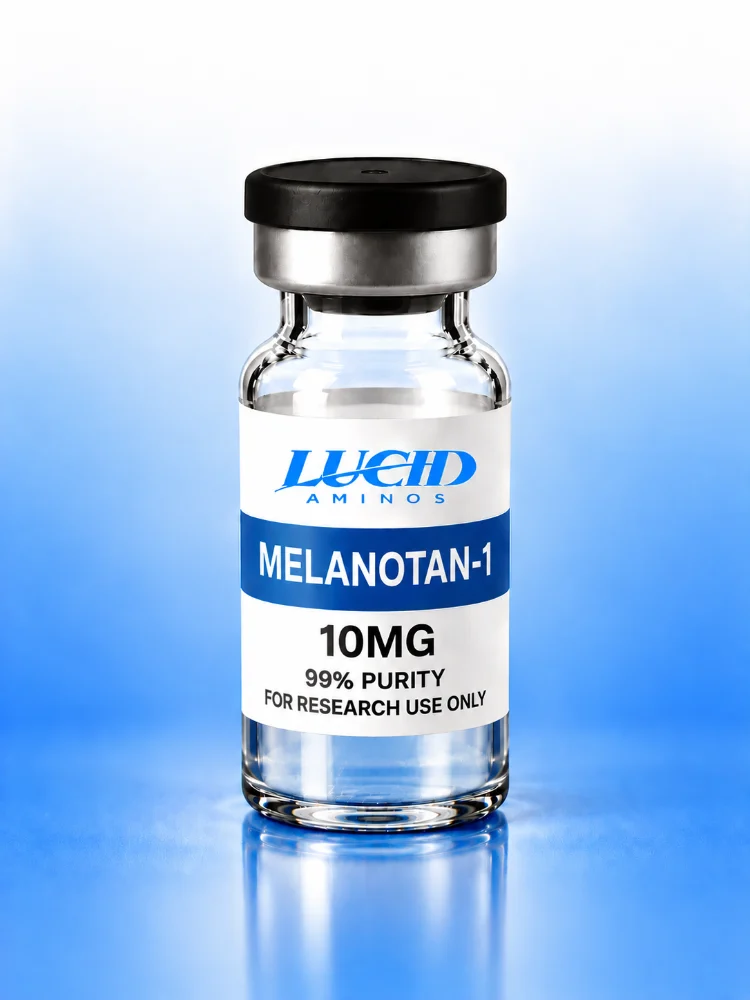
The method needs a free amine at the front. If the N-terminus is capped, the reaction cannot start. Melanotan-1 10mg has an acetyl cap and Tesamorelin carries a hexenoyl cap, so both are blocked to Edman sequencing.
Today
Mass spectrometry has largely replaced it, but Edman is still used to confirm N-terminal sequences. Keep reading.
Explore Lucid Aminos
- Shop all research compounds
- Read the lab reports (COA)
- Frequently asked questions
- Partner program
- About Lucid Aminos
- Contact us
For laboratory research use only. Not for human or veterinary use, and not intended to diagnose, treat, cure or prevent any condition. This article is educational and is not medical advice.
Lucid Aminos
Third-party tested research compounds, with a certificate of analysis for every batch.