
Blog
From Receptor to Signal: How a GHRH-Type Peptide Talks to a Cell

This article describes published laboratory science for educational purposes. It makes no claims about use in people.
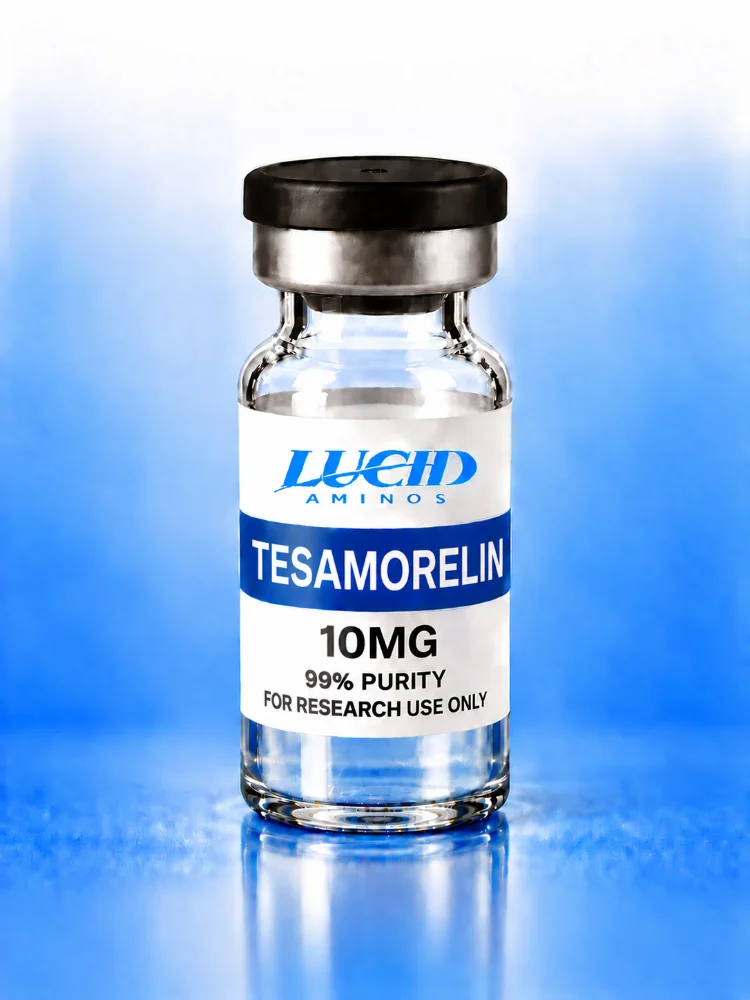
Every research peptide is a message. The GHRH family of peptides, including the analog Tesamorelin 10mg, deliver theirs through a well-mapped pathway.
Step 1: binding
The peptide docks on the GHRH receptor, a class B G protein-coupled receptor on pituitary cells. The helical middle of the peptide engages the receptor’s large outer domain, while the front end dips into the transmembrane pocket.
Step 2: the G protein switch
The receptor changes shape and activates a partner protein, Gs, which swaps GDP for GTP.
Step 3: the second messenger
Gs turns on adenylyl cyclase, an enzyme that converts ATP into cyclic AMP (cAMP).
Step 4: downstream effects
Rising cAMP activates protein kinase A, which in turn influences gene expression and hormone release in cell models.
How researchers read it out
- cAMP assays in cultured cells
- Reporter gene assays
- Dose-response curves to compare peptides
Keep reading to learn what holds this pathway in check.
Explore Lucid Aminos
- Shop all research compounds
- Read the lab reports (COA)
- Frequently asked questions
- Partner program
- About Lucid Aminos
- Contact us
For laboratory research use only. Not for human or veterinary use, and not intended to diagnose, treat, cure or prevent any condition. This article is educational and is not medical advice.