
Blog
Somatostatin: The Brake in the Growth Hormone System

This article describes published laboratory science for educational purposes. It makes no claims about use in people.
Many hormones do not flow steadily. Growth hormone is released in bursts, and the pattern is set by two hypothalamic peptides pulling in opposite directions.
The accelerator
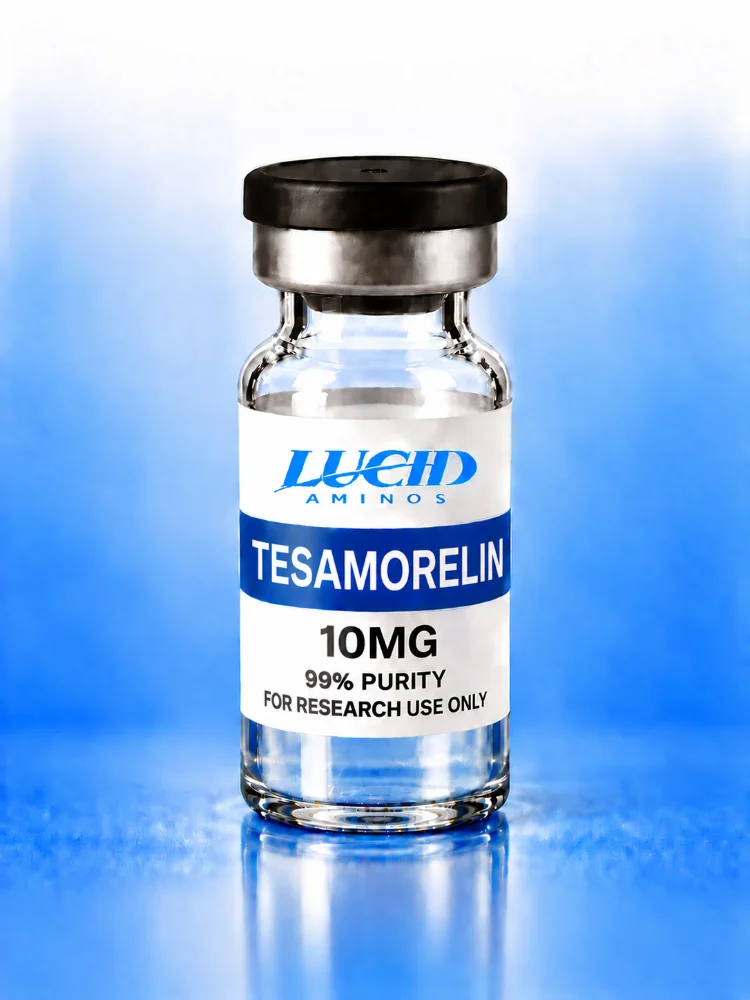
Growth hormone releasing hormone (GHRH) stimulates pituitary cells to make and release growth hormone. The 44-residue sequence is the natural form, and Tesamorelin 10mg is a stabilized research analog of it.
The brake
Somatostatin is a cyclic peptide of 14 residues (a 28-residue form also exists) with a disulfide ring. It opposes GHRH and also acts on many other tissues, which is why its name appears throughout endocrine research.
A discovery story
Somatostatin was found in the early 1970s by Roger Guillemin’s group, who were searching for a growth hormone releasing factor and instead found an inhibitor.
Why the rhythm matters
When researchers study these peptides in cells or tissue, timing matters as much as amount. A constant exposure behaves differently from a pulse, because receptors can desensitize.
Keep reading for more peptide stories.
Explore Lucid Aminos
- Shop all research compounds
- Read the lab reports (COA)
- Frequently asked questions
- Partner program
- About Lucid Aminos
- Contact us
For laboratory research use only. Not for human or veterinary use, and not intended to diagnose, treat, cure or prevent any condition. This article is educational and is not medical advice.