
Blog
Alpha-MSH Barely Changes Across Mammals: What Conservation Tells Researchers

Alpha-melanocyte stimulating hormone is 13 residues long: Ac-Ser-Tyr-Ser-Met-Glu-His-Phe-Arg-Trp-Gly-Lys-Pro-Val-NH2. In the literature, this sequence is described as identical in all the mammals studied so far.
Why conservation is a clue
Random changes accumulate in most sequences over millions of years. When a sequence stays the same, it usually means almost every residue is doing a job, so changes get weeded out.
The core and the tail
- His-Phe-Arg-Trp (positions 6-9): the core, often called the message sequence, needed for receptor activation.
- Lys-Pro-Val (positions 11-13): the C-terminal tripeptide, which is the same sequence as KPV.
What chemists did with it
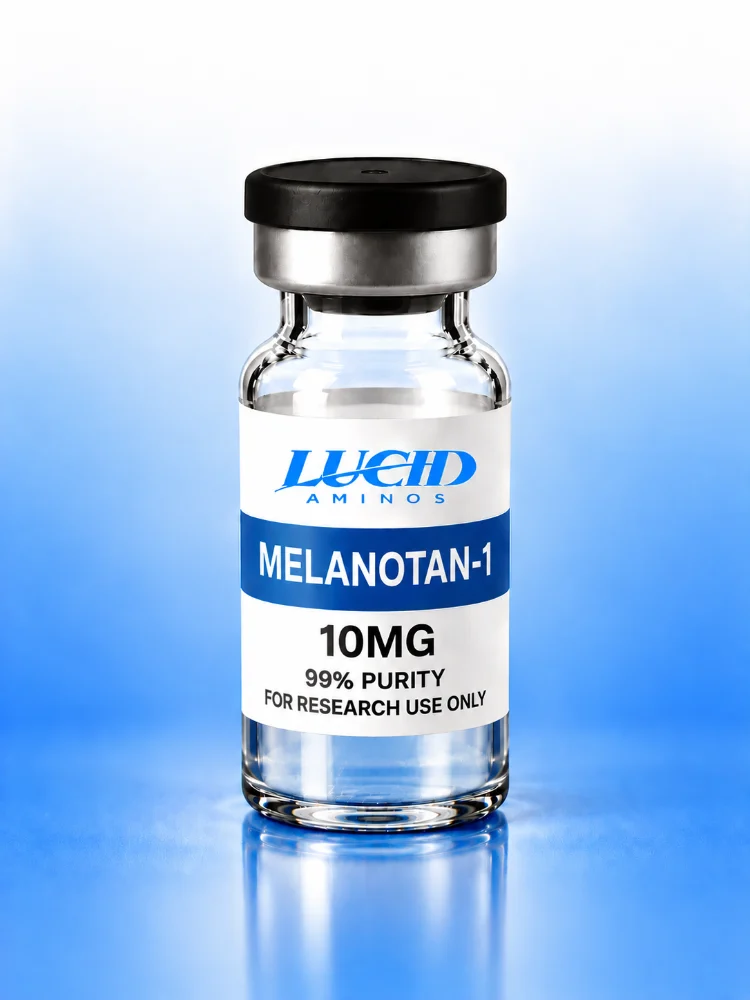
Melanotan-1 swaps two residues: norleucine for methionine at position 4 and D-phenylalanine for L-phenylalanine at position 7. Those edits keep the core and fix weak spots. See Melanotan-1 10mg, and compare to KPV 10mg.
Take-home
- Conservation signals importance.
- Medicinal chemists keep the core and edit the edges.
Explore Lucid Aminos
- Shop all research compounds
- Read the lab reports (COA)
- Frequently asked questions
- Partner program
- About Lucid Aminos
- Contact us
For laboratory research use only. Not for human or veterinary use, and not intended to diagnose, treat, cure or prevent any condition. This article is educational and is not medical advice.