
Blog
The Anatomy of NAD+: Four Parts in One Molecule

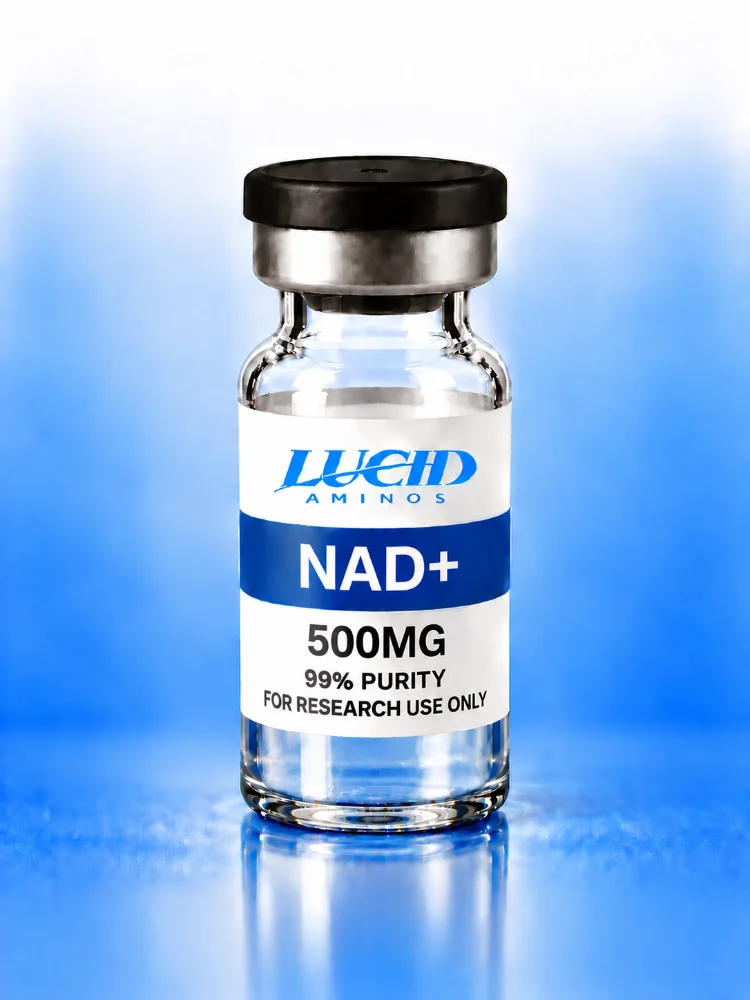
NAD+ stands for nicotinamide adenine dinucleotide. The name is also its blueprint.
Part 1: adenine
A two-ring base also found in DNA and ATP. It is the part that absorbs UV light at 260 nm.
Part 2: two ribose sugars
Each half of the molecule has a ribose sugar, a five-carbon ring that acts as the backbone.
Part 3: the pyrophosphate bridge
Two phosphate groups join the two halves. This bridge carries negative charges, which helps NAD+ dissolve in water.
Part 4: nicotinamide
The business end. The ring nitrogen carries a positive charge, which gives NAD+ its plus sign. This ring accepts a hydride and becomes NADH.
By the numbers
- Formula: C21H27N7O14P2
- Mass: about 663.4 Da
- Not a peptide: it contains no amino acids
Why the structure matters for handling
The bond joining nicotinamide to ribose is the weak link, and it breaks down in strongly alkaline conditions. See the research listing for NAD+ 500mg, and keep reading to see how the molecule is measured.
Explore Lucid Aminos
- Shop all research compounds
- Read the lab reports (COA)
- Frequently asked questions
- Partner program
- About Lucid Aminos
- Contact us
For laboratory research use only. Not for human or veterinary use, and not intended to diagnose, treat, cure or prevent any condition. This article is educational and is not medical advice.