
Blog
NAD+ Stability and pH: Why the Molecule Prefers Acid and Dislikes Base

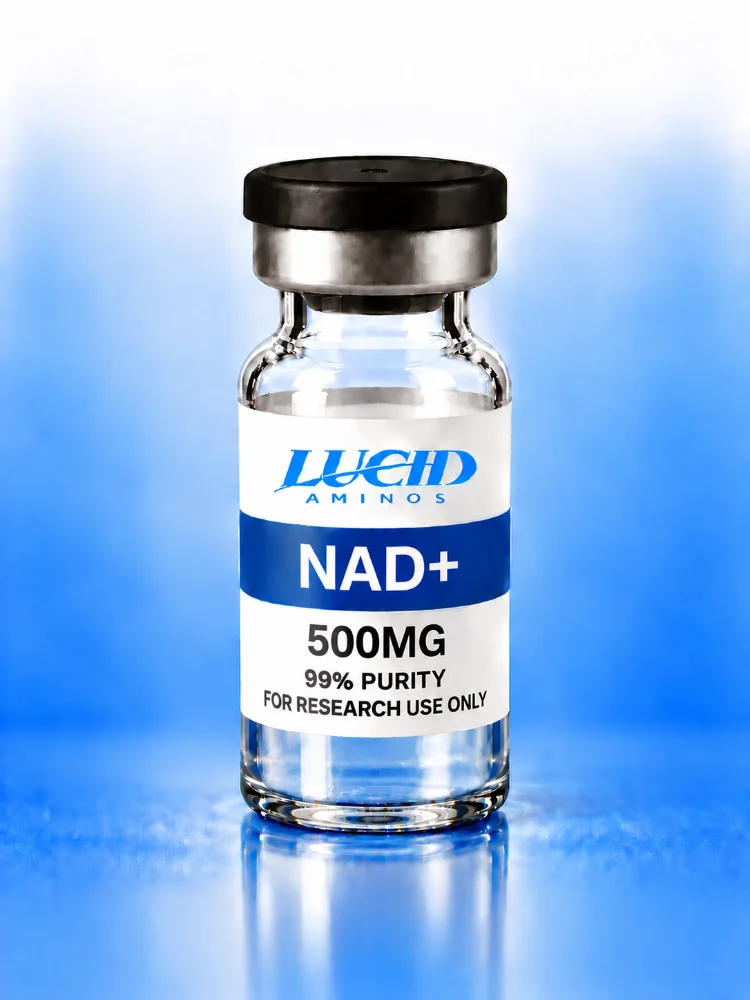
NAD+ is not a peptide, but it sits on the same shelf for many researchers, and it comes with its own handling rules. The most important is about pH. This molecule is happiest in mild acid and gets damaged in base, and the reason is the nicotinamide ring.

Key takeaways
- NAD+ (nicotinamide adenine dinucleotide) has a mass of about 663 daltons.
- The oxidized form is relatively stable in acidic solution and unstable in alkaline solution.
- The reduced form, NADH, behaves the opposite way and is acid-labile.
- Heat, light and moisture speed up breakdown, so cold, dry storage is the rule.
- Degradation produces nicotinamide and ADP-ribose, both measurable by HPLC.
What NAD+ is
NAD+ is two nucleotides joined by their phosphates, one carrying adenine and one carrying nicotinamide. It is central to metabolism and is consumed by enzymes such as those in our CD38, sirtuin and PARP post. Background is in our NAD+ overview and the Goldberger story.
Why base is a problem
The nicotinamide ring in NAD+ carries a positive charge on its nitrogen, which makes the ring open to attack. In alkaline solution, hydroxide ions add to the ring and the molecule breaks apart or rearranges. In contrast, the reduced form lacks that charge but is vulnerable to protons, so it falls apart in acid. The two forms therefore need opposite buffers.
Practical consequences
- For oxidized NAD+, a slightly acidic to neutral solution is more forgiving than a basic one.
- Avoid carbonate or other high-pH buffers for stock solutions.
- Prepare solutions fresh when possible and keep them cold.
- Protect the powder from moisture; it takes up water readily, as in our residual moisture post.
- Avoid repeated warming, and see freeze-thaw guidance.
Watching for breakdown
Degraded NAD+ shows extra peaks on HPLC and a drop in the main one. The main products are nicotinamide, which elutes early, and ADP-ribose. Quantification methods are described in our NAD+ measurement post, and the principle of trusting the full picture rather than one number is in why purity alone is not enough.
Bottom line
NAD+ rewards careful pH and temperature control. Match your buffer to the form you have, keep it cold and dry, and check lots with a proper report. See our lab reports.
Related reading
Explore Lucid Aminos
- Shop all research compounds
- Read the lab reports (COA)
- Monthly Research Panel
- Frequently asked questions
- Partner program
- About Lucid Aminos
- Contact us
For laboratory research use only. Not for human or veterinary use, and not intended to diagnose, treat, cure or prevent any condition. This article is educational and is not medical advice.